Art Is the Language of the Spirit 1968 Leonard Cohen
Belfry of Song
A Broken Hallelujah: Stone and Curlicue, Redemption, and the Life of Leonard Cohen BY Liel Leibovitz. West. W. Norton & Company. Hardcover, 288 pages. $25.
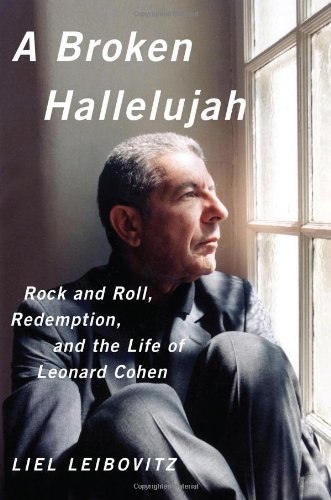
"So what is the prophet Cohen telling the states? And why practice nosotros mind so attentively?" Liel Leibovitz asks at the outset of A Broken Hallelujah, his moving portrait of the songwriter and poet Leonard Cohen. The author pursues the answers to these questions with the diligence and reverence of a religious scholar. Give thanks God. Merely Leibovitz recognizes that Cohen deserves more than mere rock biography, and so he structures A Broken Hallelujah around the premise that his field of study is, indeed, a modernistic-day prophet.
Leibovitz's business relationship abounds with proof of this assertion, fifty-fifty every bit it charts the many other personae that Cohen has assumed through his long life and distinguished career. Notwithstanding, to grasp the homo'south peculiar sense of spiritual mission, one really need look no farther than the greatest hymn of the rock 'northward' scroll era, Cohen's "Hallelujah"; in its closing verse, the singer proclaims, "I've told the truth, I didn't come to fool you / And even though it all went wrong / I'll stand before the Lord of Song / With nothing on my natural language but Hallelujah."
Leonard Cohen grew up in a wealthy Jewish family in Montreal. When he was nine years old, his father, Nathan Cohen, died from lingering injuries sustained in World War I. Young Leonard was left with his sis and mother, as well as an extended family that included his maternal grandfather, a fiery rabbi named Solomon Klinitsky-Klein, "a celebrated scholar who was known as Sar haDikdook, or the Prince of Grammarians." Later on his daughter had married into the Cohen family, the elder cleric brought into their "increasingly assimilated lives . . . a cadre of traditional values and beliefs," Leibovitz writes. Klinitsky-Klein impressed upon his grandson a "vision of Judaism radically different from the polite theology on offering at the Cohens' Conservative synagogue; its language of punishment and justice, of damnation and conservancy, was not the sort that the gentlemen in the tiptop hats spoke fluently." The linguistic communication of his grandfather's sermons gripped the young Cohen—particularly in its bright depictions of how closely the sacred and the profane tin can interact.
The latter quality, by Cohen'due south own business relationship, animated his first foray into the writing life, as an aspiring poet. Equally he explained in a 1970 interview, "I wrote notes to women then as to have them. They began to show them effectually and soon people started calling information technology poetry. When information technology didn't piece of work with women, I appealed to God." His poetry presently earned him wide praise in Canada, and, as Leibovitz explains, Cohen fell easily into the role of the uppercase-P Poet, "skillfully walking the line between genuine creative person and smirking con homo."
Cohen was increasingly absent-minded from his homeland, preferring to spend his time at the beachside home he'd bought on the Greek island of Hydra. At that place, uninterrupted by celebrity or family, he wrote. The poems gave mode to longer fiction. His debut novel, The Favorite Game, published in 1963, was received warmly by critics. 3 years later, his 2d attempt, Beautiful Losers, inspired some favorable comparisons to James Joyce just was mostly panned. Several reviewers decried the book as "filth"—and for the record, it did feature passages such equally "Her freakish nipples make me desire to tear up my desk when I remember them, which I do at this very instant, miserable newspaper memory while my cock soars hopelessly into her mangled coffin, and my arms wave my duties abroad."
By the age of 30-two, Cohen was ready to "abandon his modestly successful career as a writer and a poet." What he chose to do side by side was typically unexpected: He moved to New York Urban center to become a singer. An account of a dinner party at the beginning of 1966 serves to explicate what might take contributed to the decision. A "cohesive grouping of poets" gathered in Montreal; at i point, when the writers were all well in their cups, Cohen asked the group, "Do you know who the greatest poet in America is?" He proceeded to play them two Bob Dylan albums. Cohen's peers "loathed" the music—simply for him, it had obviously struck a prophetic chord. By the end of that same year, he had succeeded in landing two songs on Judy Collins's album In My Life—one of them his commencement signature hit, "Suzanne." The record went gilded nigh immediately.
Cohen convinced A&R guru John Hammond to requite him a shot on Columbia Records. In the late summer of 1967, a "nervous young creative person" entered Columbia'southward studios to record his cocky-titled debut anthology. It was a disquisitional success, but Cohen's popular appeal would exist a long time coming: The music scene that greeted the release of Cohen's debut was none too receptive to his austere and haunting balladry. "Past 1969 Americans didn't want redemption negotiated somberly to the tune of a solitary guitar," Leibovitz writes. "They wanted it to come in bursts of sound, firsthand, orgasmic."
Cohen establish his start significant post-obit in Europe. Though he'd never been fond of live performance and had never been on a proper tour, his management and record characterization finally persuaded him to embark on a string of European concert dates in May 1970. He convinced famed producer Bob Johnston to exist his tour manager and keyboard thespian. The tour got off to a bad starting time and never quite recovered. At the 2d prove, in Hamburg, for instance, Cohen began goose-stepping onstage and sparked a near riot. "Cohen'southward entourage, feeling more than like a armed forces unit of measurement than a band of touring musicians, became known every bit the Ground forces." Cohen, the Army'due south commander, led them from one uncomfortable scene to some other. It seems fitting that he had the idea to wrap up the bout with a gig in a mental institution merely south of London. By all accounts, that evidence was the best of the tour. At its terminate, Cohen announced to the inmates, "I really wanted to say that this is the audience that we've been looking for. I've never felt so good playing earlier people earlier."
A 1972 tour proceeded even more disastrously, cheers in large part to a poor sound organisation. With '70s pop music slouching druggily toward prog rock and bloated backlog, Cohen's stark minimalism must accept never seemed starker. Cohen again went into expat mode; in 1973, he traveled to Israel, where the Yom Kippur War had broken out. He institute himself a part of a modest group of musicians moving beyond the front line, playing for handfuls of soldiers between bouts of cannon fire.
The experience refreshed Cohen. The following year, he told a journalist, "War is wonderful. They'll never stamp information technology out. Information technology'due south ane of the few times people can deed their best. It'southward and so economical in terms of gesture and movement, every single gesture is precise, every effort is at its maximum. Nobody goofs off. Everybody is responsible for his blood brother. The sense of community and kinship and brotherhood, devotion. In that location are opportunities to feel things that you lot simply cannot feel in mod city life. Very impressive."
As the '70s wore on, the "poet of loneliness" constitute himself very alone in his early forties, wandering from urban center to city. This country of geographic pilgrimage flowed, like many phases of Cohen's life, into a spiritual quest. He became drawn to Buddhist meditation, and began to practice the Rinzai tradition. The merger of Cohen's prophetic Jewish faith with contemplative Buddhist devotion was an improvisation of sorts, but as Leibovitz notes, it came naturally to Cohen: "Similar God, the pious must learn to be in loneliness while striving all the while to create the world around them." Cohen would spend much of the adjacent 2 decades on tiptop of Mount Baldy in Southern California, living in the monastery of an old monk named Roshi. When he emerged in the midst of his informal exile in 1984 with Various Positions, the album revealed a different, more intensely spiritual side of the artist.
Information technology was fitting that Bob Dylan, who'd helped inspire Cohen'south musical career, recognized the album'south deeper religious avidity; the new songs, Dylan noted, "sounded like prayers." This was peculiarly the example for what is now Cohen's most celebrated composition, "Hallelujah," a song not so much about catholic divinity as it is nearly the humility bound up with the ritual invocation of the divine. As Leibovitz explains of the song's narrator, "He couldn't experience, and so he wrote a song, understanding that the Holy Ghost may preside over the occasional copulation, but that if humans were ever to run into their maker—the Lord of Vocal—the fashion to do information technology was through ritual, imperfect and frequently devoid of emotion but ultimately and cosmically effective."
In the late '80s and early '90s, the culture caught upward with Leonard Cohen. Suddenly, the former outcast poet, who'd been drowned out by much of the Dionysian din of '60s rock, was historic every bit a hero—to Bono, Jeff Buckley, the Pixies, R.Due east.M., and anybody else who knew what it meant to be cool. By Leibovitz's account, he enjoyed the new acclamation—to an extent. He found himself attending the Oscars, engaged to moving picture star Rebecca De Mornay, shooting music videos, feted and beloved. He went on lengthy (past his standards) tours in 1988 and 1993. Notwithstanding, Leibovitz notes, the new renown was also "exhausting. Cohen drank. For reasons known only to them, he and De Mornay ended their engagement." He spent the next five years marching with the monks atop Mount Baldy. Just he wasn't washed. He needed the work. Ten New Songs and Dear Heather were well received, the latter earning a beautiful tribute from the groovy Village Vocalization critic Robert Christgau in which he lovingly describes Cohen's "No Voice."
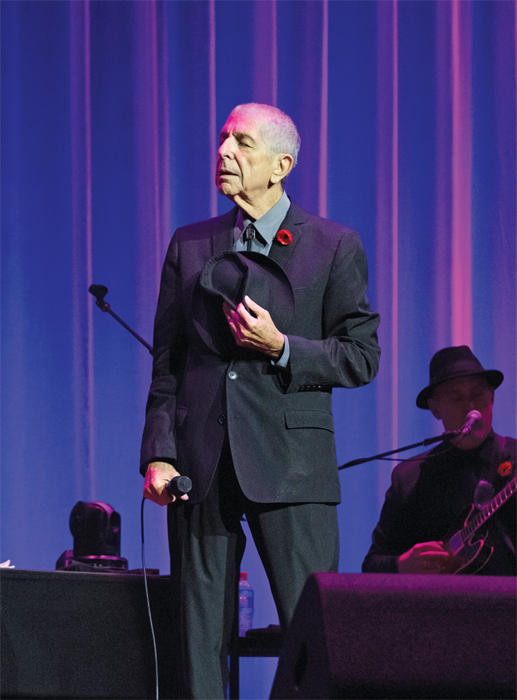
In the mid-2000s, Cohen discovered he had been rendered destitute by a former manager'southward embezzlement. The only option he had to pull himself out of the hole was to bout. After two decades spent in and out of a monastery, Cohen was able to adopt a different approach to live performance. Cohen became a confident performer, killing information technology for three hours a night in forepart of sold-out houses, and playing a lifetime'southward worth of songs for an adoring public. "The human relationship was different now," Leibovitz writes. "He had discovered an intimacy greater than the ane he had grasped for equally a young artist when he urged the audience to come up closer. To bring them closer, he now knew, to be one with his fans, he just had to sing."
A like celebratory communion is accomplished in A Broken Hallelujah. Leibovitz masterfully teases out the many powerful, and only provisionally resolved, spiritual longings that characterize Cohen's work—no thing how profane its content may seem at outset blush. Through all of the many reversals, switchbacks, and religious sabbaticals that have shaped his subject field'southward unique place in pop music, Leibovitz shows Cohen'southward humanity shining through—while making information technology abundantly clear that he is beginning and foremost a prophet.
Rhett Miller is the lead singer of the band Old 97's, which released its tenth album, Most Messed Upwards, in Apr. He is as well a solo creative person, and has written reviews and criticism for Salon and Bookforum.
miltenbergervotearome.blogspot.com
Source: https://www.bookforum.com/print/2102/a-new-biography-retraces-leonard-cohen-s-longings-for-the-flesh-and-spirit-13302

Post a Comment for "Art Is the Language of the Spirit 1968 Leonard Cohen"