Salesforce Dataloader Bulk Upload Trigger Not Running
Introduction to bulk updates in Salesforce
Salesforce majority updates tin can be frustrating, irksome, and require tons of manual piece of work, but they don't have to exist. In this guide, we'll walk yous through the ins and outs of mass updating records in Salesforce to ensure superb information hygiene and maximize sales productivity. Feel free to utilise the linked table of contents in a higher place to skip directly to the sections you need, or read on for the full story.
If you're already a seasoned Salesforce pro, hop down to our section on the tools, technologies, and techniques you'll want to consider when making bulk updates. Otherwise, keep scrolling to learn why regular updates are important, which record types you'll desire to keep an center out for, and common bulk data projects.
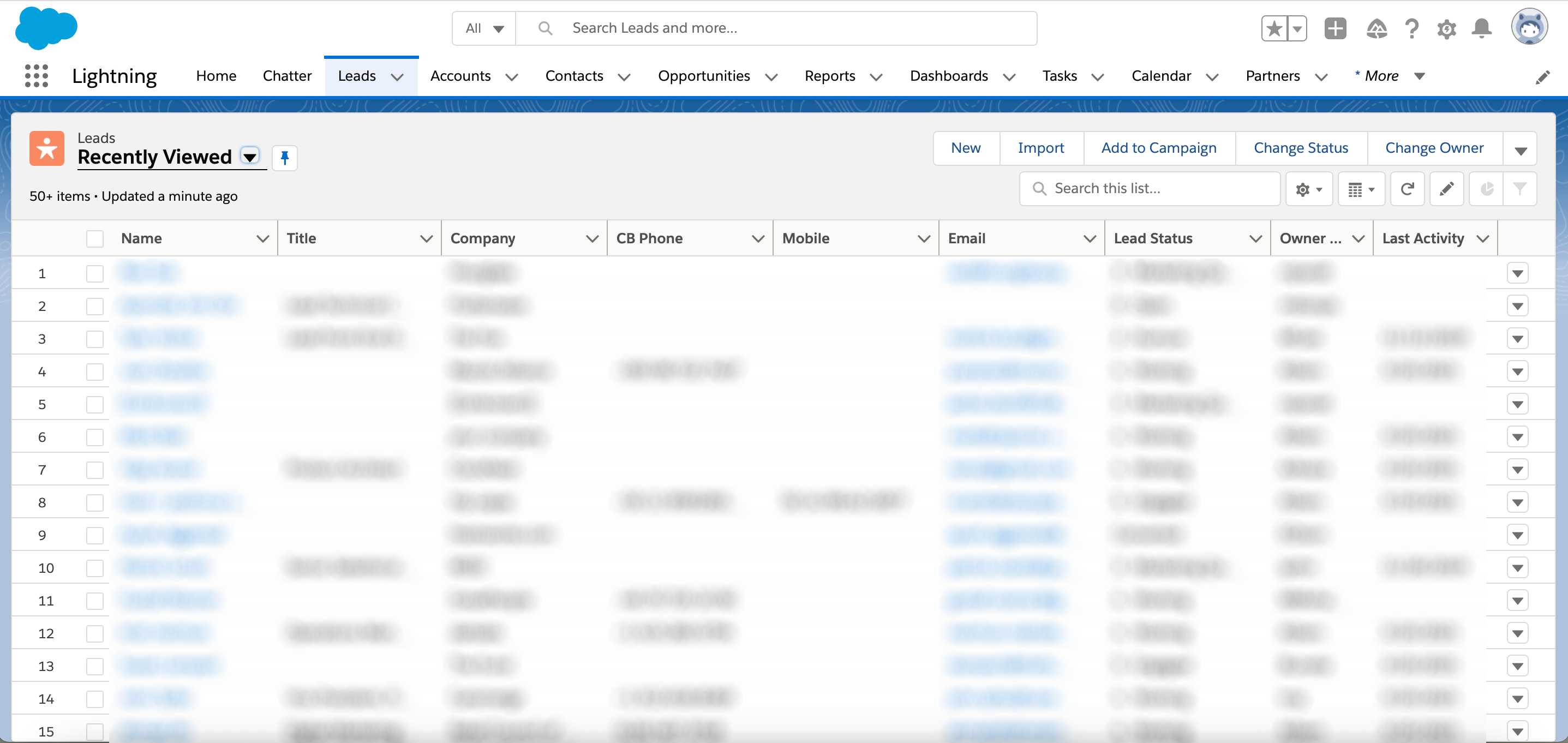 A lead list in Salesforce Lightning.
Why Salesforce bulk updates matter
Bulk updates in CRMs like Salesforce are a common pain point for sales operations professionals, CRM administrators, and anyone who manages extensive amounts of CRM data. Salesforce, like many CRM applications, has many dissimilar fields to runway the kind of standard data yous'd expect to see in a CRM, such every bit sales opportunities, accounts, contacts, and leads...to say nothing of the many custom fields your company may employ for its own unique business needs. The trouble isn't just that many companies use their CRMs as a system of record to runway all these different types of data, but as well that so much data is constantly in a land of flux.
For example, revenue teams often reassign accounts to different teams or territories, suit contract statuses, or modify the scoring of leads in their funnel, which tin can bear on multiple accounts (and every data field associated with those accounts). The result is unremarkably the same: Someone has to go into the CRM and mass update leads in Salesforce (or mass edit opportunities in Salesforce, as the case may exist). And unfortunately, Salesforce batch update jobs tend to involve messy spreadsheets, incomplete data, and hours of fault-prone manual work.
That'southward why we assembled this guide to help y'all navigate the challenges of mass edits in Salesforce. We'll embrace everything from standard objects in Salesforce, to mass updating leads, to the role of API integrations - the way that applications like your CRM connect to others at the software level - and how they can help you automate manual work.
The price of bad information
CRMs like Salesforce are home to essential records and data that your organization depends on to drive revenue and retain customers. Only the value of that information decreases over fourth dimension: 20-25% of the average database decays every twelvemonth as your prospects and customers change their emails, job titles, and mailing addresses. At the aforementioned time, your sales squad is eager for rapid admission to fresh new leads from marketing campaigns and your sales development representatives (SDRs), only manual list uploads take time to format and deliver.
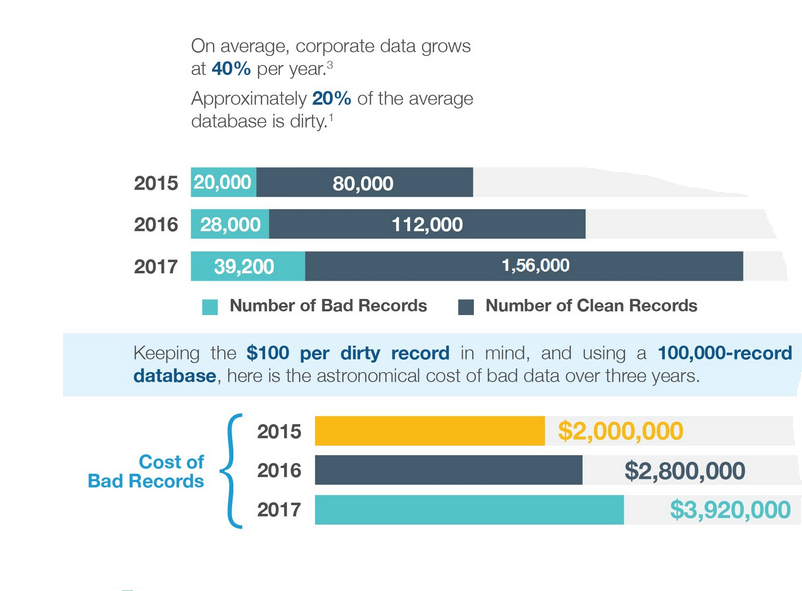 The impact of bad data on your CRM. Source: Neil Patel
Then how do mass edits in Salesforce brand a divergence? Past editing a high volume of records in a single job, you can ensure that the majority of your CRM stays up-to-date in real-fourth dimension, even when dealing with thousands of customer records. Additionally, calculation net-new lead lists to Salesforce in batch keeps your formatting consistent and prevents duplicate records, which slow down sales reps and make reporting less reliable. Over time, indistinguishable records can pile up and require additional information maintenance jobs to ensure accurateness.
All in all, batch updates in Salesforce are an effective fashion to ensure fast and reliable customer data and then that your squad can shorten bargain cycles and brand sure sales isn't wasting fourth dimension by chasing leads with stale, outdated information. But before nosotros dive into the different kinds of Salesforce batch updates, let's take a step back and review the bones schema of objects and tape types in Salesforce. For reference, a schema is a framework of all dissimilar data types and their relationships within a certain tool.
Objects and tape types in Salesforce
In Salesforce, objects are storage units that we utilise to associate information with a specific lead, business relationship, or other business concern entity. Objects remove many of the traditional issues of working in a spreadsheet, like hard-to-find data and excess scrolling, by separating rows (or records) into single, visual blocks.
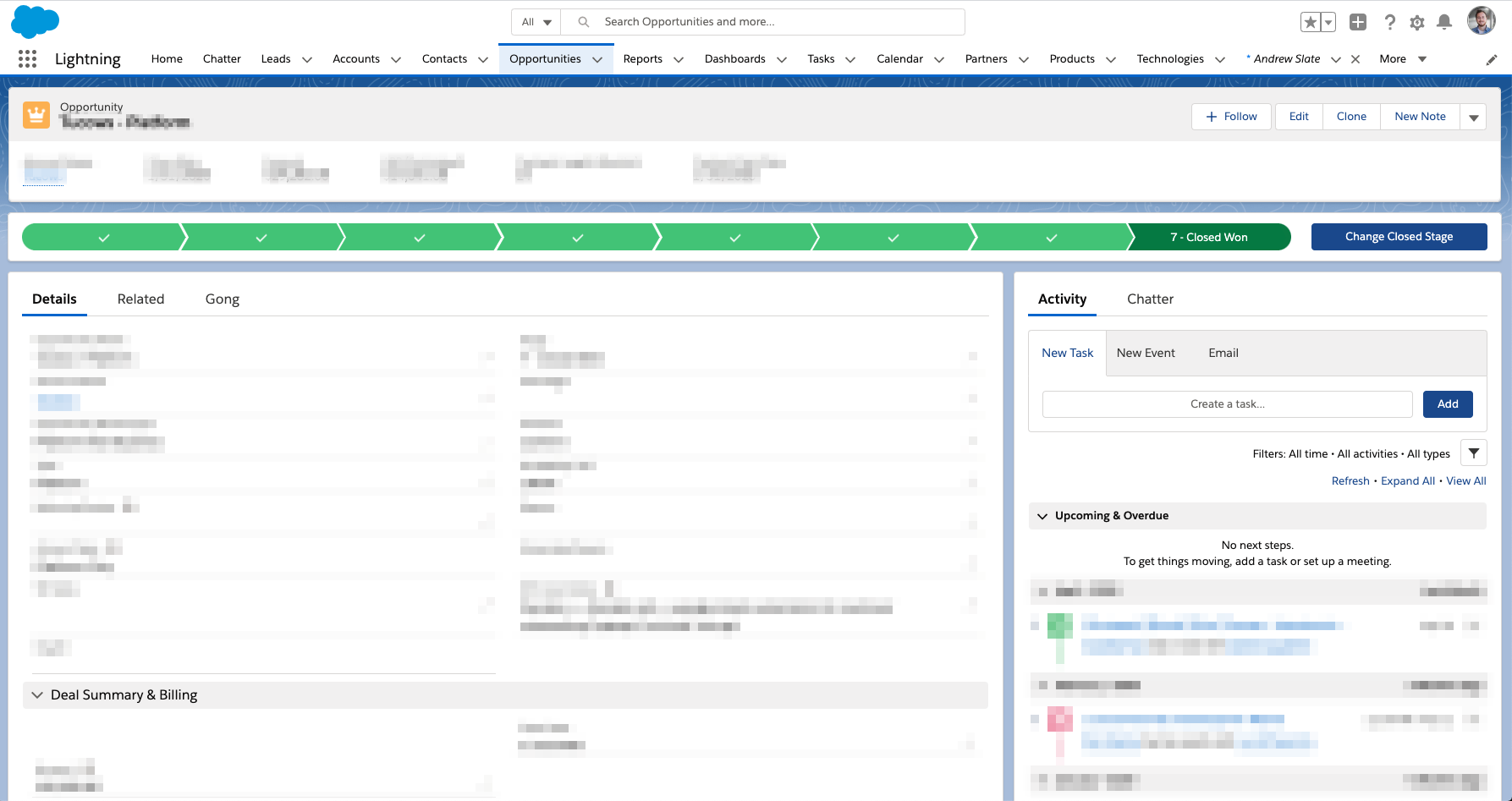 An example of an object in Salesforce
There are two main types of objects in Salesforce:
- Standard objects are objects included in Salesforce out-of-the-box. These include mutual business concern records such as leads, contacts, opportunities, accounts, products, users, and campaigns.
- Custom objects are objects created past your Salesforce ambassador that house records unique to your line of business. For instance, if you ain an auto repair shop, yous might consider creating a custom object for the different repair services you offer. Or, if you rent speed boats, yous can create a custom object to shop information about each boat.
When should I use custom objects in my Salesforce example?
While information technology may exist tempting to create make-new objects to represent unique production offerings or other industry-specific records, many Salesforce administrators recommend that you use custom objects sparingly.
Custom objects don't support many of the latest and greatest features from Salesforce, meaning that if a futurity update includes a new field or functionality that you'd similar to include on your custom production object, you may accept to revert to a standard object. Additionally, custom objects can create challenges when merging multiple different instances or team processes.
What are fields in Salesforce?
Every object stores multiple fields, which act as containers for individual units of information. Standard objects contain some pre-built fields, merely you tin add custom fields that, similar to custom objects, permit you customize your data in Salesforce. All objects, including custom objects, comprise a standard set of fields that place the object with an ID (we'll bear on record IDs later in the post), store a name for the object, and runway changes to the object with timestamps.
 An example of a field in Salesforce
Standard Objects in Salesforce
Let's review a few of the standard (out-of-the-box) objects in Salesforce. For a full list of standard objects and standard fields, check out Salesforce'due south official listing hither.
Leads and Contacts
A lead object in Salesforce contains information about your organization'south sales-qualified leads (SQLs). Your sales team uses lead objects to track the condition of a given lead as it moves further down the funnel. Salesforce pb objects come pre-built with fields including proper noun, email, address, company proper noun, industry, and rating. Leads typically nest inside a specific opportunity object.
A contact object, on the other manus, contains data most customers that already have accounts with your concern. Leads are automatically converted into contacts whenever an opportunity changes to an account. Your customer support and account teams utilize contact objects to record useful data that drives retention and ensures a seamless experience. Contacts contain many of the same fields as leads.
Opportunities and Accounts
An opportunity object in Salesforce represents the broader business opportunity that your business organization has with a potential client. Opportunity objects come up pre-congenital with fields such as account name, opportunity stage, close date, expected revenue, and probability of closing.
Business relationship objects in Salesforce map to actual organizations that are either interested in your business organisation or are a current customer. Account objects tin take multiple contacts, opportunities, or other objects associated with them, and comprise fields such every bit business relationship source, almanac revenue, last activity, and billing accost.
Campaigns, products, and users
Entrada objects rail marketing program effectiveness past segmenting leads and accounts associated with specific campaigns. Campaign objects include fields such every bit cost, get-go appointment, end date, expected response, and total value.
Production objects represent the different products or services offered past your company. Product objects include fields such as name, description, and product family.
User objects represent internal Salesforce users in your company. Typically Salesforce admins use the user object to manage licenses and reassign records to dissimilar owners. User objects include fields such as name, part, engagement of last login, and email.
What are Record types in Salesforce?
Record types in Salesforce (not to be confused with Record IDs) let you lot personalize your objects for different teams and concern users. If, for example, you have separate sales motions for two unlike products, record types in Salesforce allow you to generate unique picklist values for both production A's sales team and production B'southward sales team. To learn more about creating record types in Salesforce, check out Salesforce's official guide here.
What are Salesforce Record IDs, and why are they of import?
Every object in Salesforce has a unique 15-grapheme ID that distinguishes it from other objects and is auto-generated. The first 3 characters volition provide the object (east.g.: 001 = Business relationship) and the remaining characters will signal to an unique record within the object. These IDs are essential to completing many jobs in Salesforce.
To locate an object's record ID, you can manually find the standard ID field inside the object, or pull the cord of digits from the end of an object page'south URL.
Example: tray.salesforce.com/ 400347127327dim
When making mass edits to existing objects using the Salesforce API, y'all need to convert the 15-character, example sensitive tape ID to a 18-grapheme, instance insensitive version to ensure that you update the correct records and foreclose errors. You can hands create a formula that will provide the 18-character version in the formula editor using CASESAFEID(Id).
Why we work with Salesforce data in batch
Working with Salesforce in batch minimizes the transmission effort involved in maintaining clean and reliable CRM data. By batch updating Salesforce, you tin procedure significantly more records in a shorter period versus editing records one-past-one. And at some companies, where CRMs contain tens of thousands of records with hundreds more than added daily, Salesforce batch updates are essential to keep footstep with the momentum of new business. After all, the ROI of a properly-maintained CRM can exist 2x your investment in time and resource.
Who works with Salesforce data?
While every company is unlike, there are a few common roles that manage data in Salesforce. These include:
- Sales and revenue operations - Sales and revenue operations professionals traditionally manage the technology and processes surrounding sales, including CRMs like Salesforce. While sales and revenue ops professionals spend the majority of their time in Salesforce CRM, they also often back up the broader revenue team by maintaining data in other applications for marketing and services, such equally Salesforce Marketing Cloud and Service Cloud, as well.
- Marketing operations - Marketing operations professionals support both sales and marketing teams by managing the technology and processes that touch a atomic number 82 before the sales handoff. As such, marketing operations professionals primarily work with campaigns in marketing automation platforms and projects in Salesforce CRM.
- Client operations - Client operations professionals manage the engineering and processes that touch an account after they become a customer. Like to marketing operations, customer operations professionals will typically work out of helpdesk applications, but too support projects in Salesforce CRM to keep sales teams up-to-date with renewals and client campaigns.
Permit'south take a await at some of the projects that sales, marketing, and client operations professionals work on in Salesforce.
Mutual data projects in Salesforce
As a sales, marketing, or client operations professional, you lot'll work on whatever number of data projects in Salesforce CRM. These projects might include adding a lead list from your latest effect, purging dummy records, or syncing data beyond multiple systems of record. Here are a few examples of the kinds of information projects for Salesforce:
List uploads
On occasion, your marketing team will uncover a hot new list of leads or accounts that they'd similar to pass along to sales to qualify and follow-up. Sometimes, these atomic number 82 lists come from virtual events or other need gen offers, where leads register with their name, email, and basic context nearly their interests. On other teams, an business relationship-based marketer will craft tailored lists of loftier-intent accounts that have expressed interest in your products and will want to assign them to your strategic sales team.
To mass update leads in Salesforce, you'll starting time consolidate and format the data into a single make clean spreadsheet. And then, you'll upload the data in a single batch, rather than manually editing each record. With batch list uploads, you can apace provide your sales team with the atomic number 82 or opportunity data that they need to execute and win deals.
Bulk information enrichment
Information enrichment, or pb enrichment, is the procedure of updating incomplete sales records with missing contact details that would've otherwise prevented your sales team from contacting those leads. If your sales squad has to spend fourth dimension researching and enriching an incomplete lead record, they will take longer to follow-up. With majority data enrichment, yous can enrich thousands of records at in one case, assuasive your sales reps to follow-upward faster. In plow, faster follow-upward increases sales conversion rates, as your team tin can achieve leads before they consider other services. You can use popular enrichment services(such as Clearbit, Datafox, and ZoomInfo) to observe information such as alternative emails, job titles, firmographics (details about an individual'south place of work), and more.
Merely how do y'all bring enrichment data into your CRM? By enriching records in majority, you tin can drastically decrease the number of leads missing or inaccurate data and, in turn, lift conversion rates.
Ongoing information hygiene
Data hygiene is a tedious but loftier-impact projection that involves updating outdated records and ensuring data consistency across your CRM. As your team runs tests or encounters software errors, information technology is natural that dummy records and other information with no business concern value find their way into your CRM. At the same time, data quality decays over time, so older records should be reviewed and updated accordingly.
Manual data hygiene projects can easily take hours out of your day when your records number in the thousands or millions. Past updating records in bulk, you can salve meaning time and refocus on more than loftier-impact initiatives.
Multi-CRM syncs
In some cases, if y'all work at an enterprise that acquired a smaller company, and with it, their sales team, your sales organization may be using multiple CRMs at the same time. Multi-CRM syncs regularly update records in each system so that your separate teams don't finish upward chasing the aforementioned leads or follow-upward with the same accounts.
Analytics and reporting
An essential office of any sales system is analytics and reporting. As a sales, marketing, or customer operations professional, y'all'll demand to piece of work with Salesforce data in bulk to pull sales data and metrics that can streamline your sales movement and increase customer satisfaction.
Challenges with Salesforce batch updates
By updating Salesforce in batch, you can do significantly more with less effort, but batch updates come with their own fix of challenges, likewise. Loading unreliable data into Salesforce tin can significantly dampen sales productivity, as your sales reps waste hours tracking down accurate contact data instead of really selling. And tiresome transmission list uploads can touch sales follow-up speed, which has a direct bear upon on conversion rates. Meanwhile, conflicting processes and object types in larger organizations can atomic number 82 to decreased efficiency and poor customer experience, equally your sales team works through two or more unlike systems and tin easily send off-putting duplicate emails to a customer.
Allow's take a look at a few of the challenges that sales operations pros face when making Salesforce batch updates.
Claiming #1: Bad data
Bad or unreliable data poses a serious risk to whatsoever Salesforce batch update or projection. After all, the goal of Salesforce maintenance is to increase the quality of data in your CRM. But bad data can easily discover its way into your projects. For ane, your teammates that provide lead lists or other records tin can unknowingly pass forth bad data. Or, through misformatted fields or other manual errors, you can create bad data during the loading procedure.
How does bad data impact sales productivity?
Bad CRM data tin accept a severe impact on sales productivity, every bit your reps can't contact leads with no contact data. Or, your reps will waste product fourth dimension hunting down accurate contact data. Bad data besides causes inaccurate reporting and analytics, pain your ability to accurately forecast and budget every quarter. Poor data hygiene costs the U.s.a. economy an estimated $three trillion each twelvemonth.
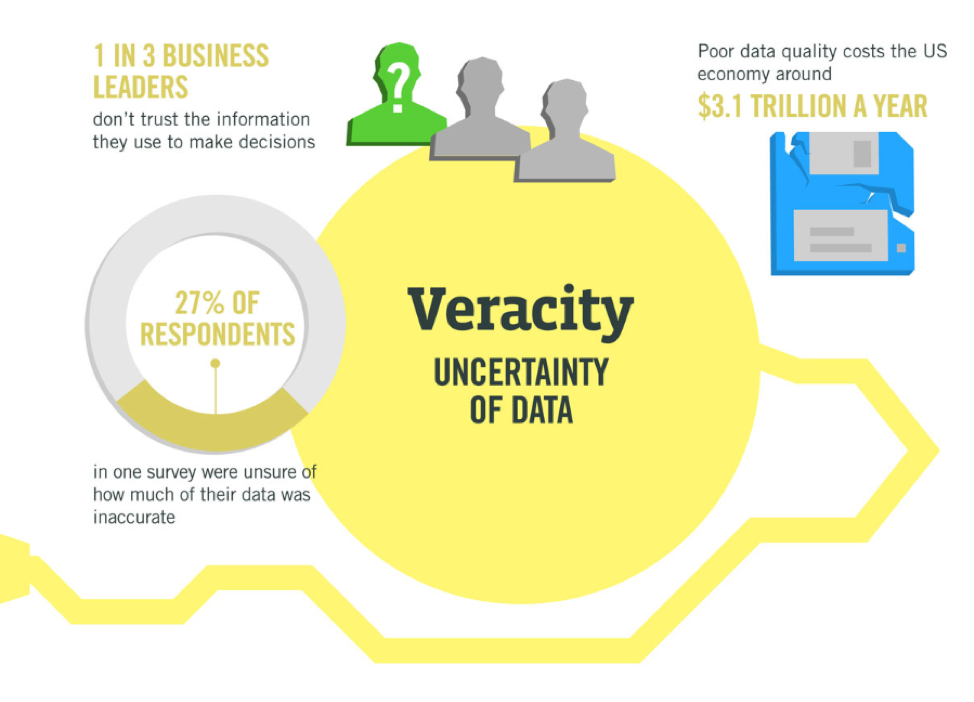 The cost of bad data to the average business. Source: IBM
Claiming #two: Tiresome list uploads
List uploads can have time, peculiarly when new atomic number 82 lists comprise thousands of records. To start, you'll need to sort and format your data and so that it can cleanly load into Salesforce. And then, you'll want to look out for bad data and missing fields, which yous'll need to confirm with the listing owner. If you're looking to mass edit existing leads or contacts in Salesforce, you'll come across like challenges, like missing record IDs (these are essential to make changes to existing records). All in all, batch uploads and updates to existing records in Salesforce can hands take days to process.
How practice ho-hum list uploads bear on conversion rates?
In sales, speed is everything. Instant follow-up with leads tin boost conversion rates 4x, significant that even a delay of mere minutes adversely impacts sales outcomes. During that time, your leads can research other vendors, find alternative solutions, or reconsider their needs entirely. Equally a result, your sales team will always exist eager to jump on the side by side hot lead. But manual list uploads tin slow the process and ultimately hurt conversion rates.
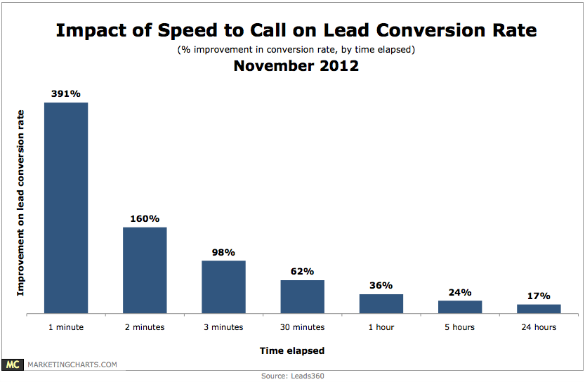 Impact of speed on pb conversion rates. Source: TOPO
Challenge #3: Conflicting CRM instances or sales processes
In larger sales organizations, dissimilar teams may follow separate processes when maintaining records in their CRM. Process inconsistencies across multiple CRM instances can exacerbate existing challenges with information hygiene and timely list uploads. Often, 1 process or platform might require different formatting than the other. And it tin be a struggle to sync records between multiple CRMs, leading to duplicate data.
How do conflicting CRM instances touch overall sales effectiveness?
Multiple CRMs create confusion for sales teams, cut into sales productivity, and potentially harm customer experience. If one atomic number 82 exists in two separate CRM instances, they may be contacted with indistinguishable offers or receive twice as much campaign correspondence, frustrating potential customers and reducing the credibility of your business. Simultaneously, your sales team will need to invest more time into cross-referencing lead information, leaving them less time edifice relationships.
How to mass update objects in Salesforce using APIs
So how can you add or update data in Salesforce while avoiding delays and bad data? Luckily, you have a few tools at your disposal that leverage the Salesforce API. Using APIs, you tin motion data from one source (like a spreadsheet) to another (in this case, Salesforce).
Salesforce's native information management tool for batch jobs is the Salesforce Data Loader. Some other pop pick is dataloader.io, which offers much of the same functionality as Data Loader in a cloud-based platform. Salesforce acquired dataloader.io, then while both tools operate under dissimilar names, they are virtually the aforementioned. In this guide, we'll focus primarily on Data Loader, merely feel free to stick with whichever tool you feel well-nigh comfy with.
Salesforce Data Loader basics
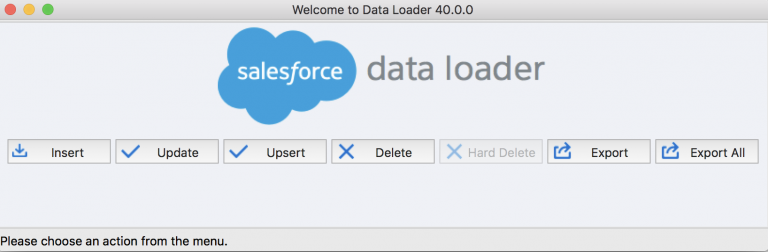 The Salesforce Data Loader
According to Salesforce, "Data Loader is a customer application for the majority import or consign of information." You lot can utilize Data Loader to insert, update, upsert, or delete data in Salesforce via its user interface or from the Command Line in Windows. Hither are a few pros and cons to using Information Loader:
Pros:
- Adept for uncomplicated, ane-off jobs
- Free Salesforce information loading tool
- Can execute seven main functions: Insert, Update, Upsert, Delete, Hard Delete, Export, and Consign All.
Cons:
- Requires y'all to format data before loading it into Salesforce
- Static operations with limited flexibility
- Occasional bugs, timeouts, and crashes
Information Loader best practices
Watch: Salesforce's all-time practices for importing data
Before beginning any data project in Salesforce, yous should make sure that you have all the information you need to execute the chore from the list owner or projection manager. If you're mass updating existing contacts, for example, yous'll need the unique RecordID of each contact in Salesforce.
When yous take your data set up, create a template in a spreadsheet for the particular object y'all want to update, including every required field in the object. Make sure to keep an heart out on any required legacy fields that might cause errors. Too, exist certain to keep in listen object dependencies. Then, you can organize and format your data and so that it matches the template yous've set.
Salesforce recommends loading a unmarried record offset to ostend that you've formatted your data correctly, and then loading the rest of your listing. Subsequently, be sure to validate your data with manual checks and brand changes to any failed uploads.
Note: Timeouts are a mutual and very frustrating problem with Salesforce Data Loader, equally you lot're processing large volumes of data in a single job and sometimes the software fails. To avoid timeouts, y'all'll need to lower your default batch size to process less records at a time. Lower batch sizes come with their own drawbacks, as large jobs can take significant time to procedure and you run the risk of hitting daily batch limits.
An culling to Information Loader: General Automation Platforms
If you're looking to automate ongoing data work, the Salesforce Data Loader won't suffice. Another option that many leading enterprises and fast-growing companies utilise is a General Automation Platform (GAP). A GAP is a visual, low-lawmaking platform that tin can movement and transform information from one endpoint to some other. Similar to a information loading tool, GAPs can connect to APIs to mass edit data in Salesforce, only without the hassle of having to manually double-check spreadsheet data or errors from the Data Loader.
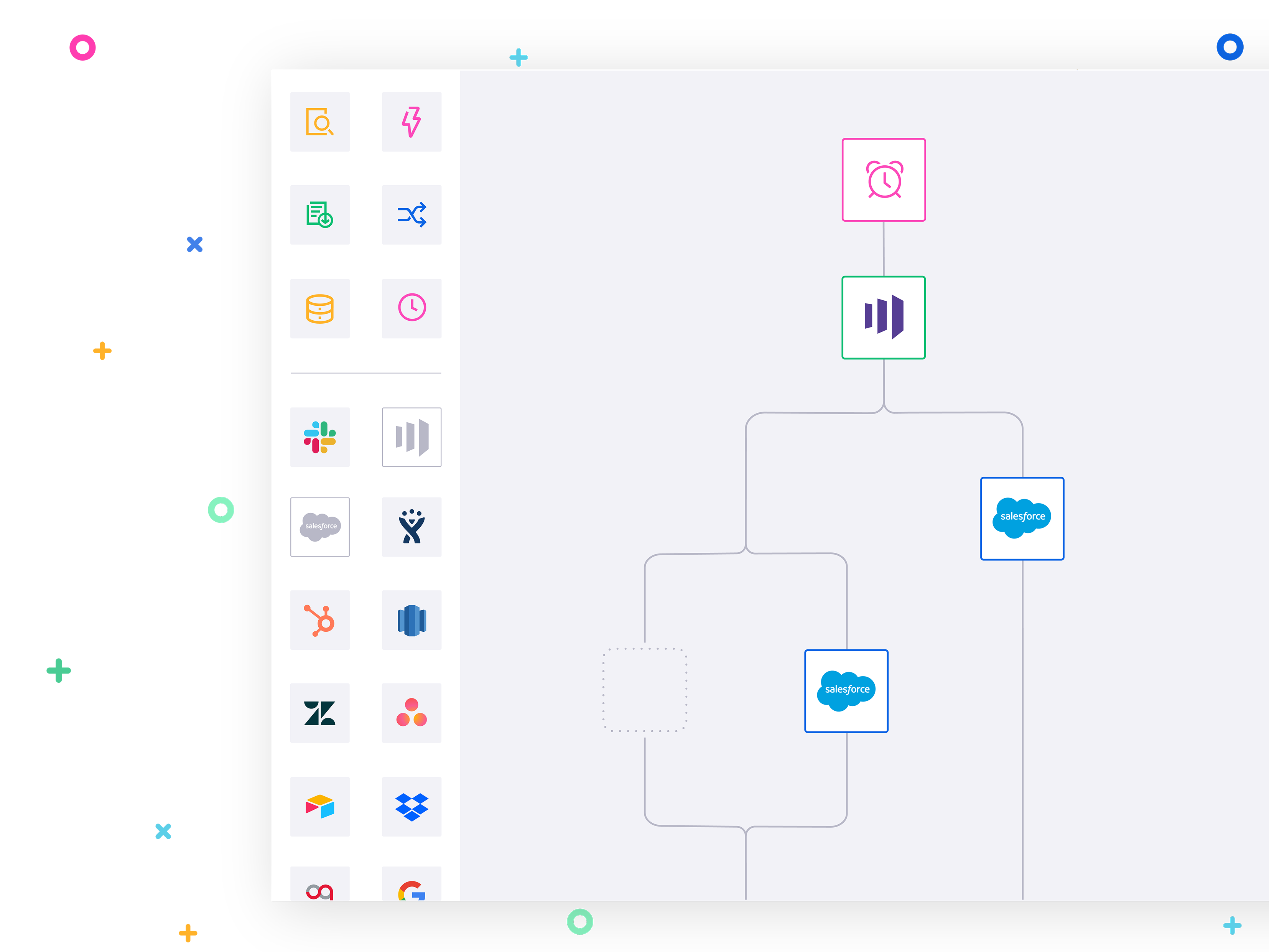 A General Automation Platform
Additionally, GAPs tin can pass information through logic-based helpers that manipulate and reformat data earlier it enters your CRM, so you lot tin automate much of the piece of work involved in data retrieval and cleanup. Using GAPs, yous can integrate important tools similar data enrichment solutions directly to your CRM, which makes painful, multi-step pb direction processes a breeze. The flexibility of GAPs lets you streamline mutual information projects, including mass updating leads in Salesforce, data hygiene, and much more.
Using General Automation to update Salesforce in bulk
One of the many ways you can utilize General Automation to mass edit Salesforce is past optimizing your ongoing data hygiene processes. A common challenge in information cleanliness is consistency. If you change your product names or processes, you'll need to update older records to prevent confusion in your sales reps and ensure authentic reporting. This one-off update can apace plough into multiple iterations to ensure an organized and authentic CRM. Instead, you can use a GAP to mass edit opportunities in Salesforce:
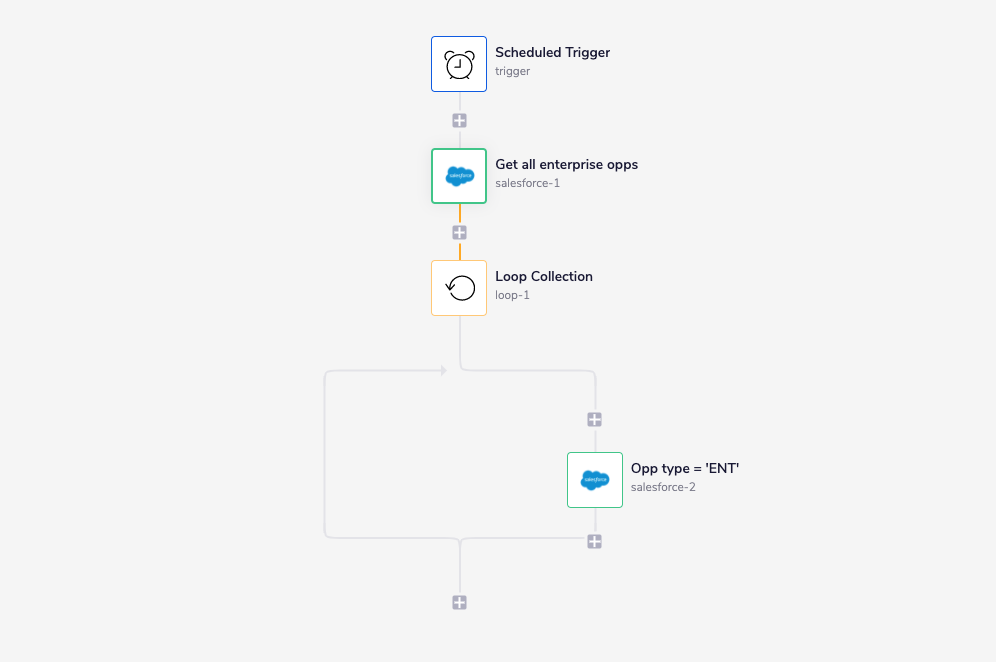 Identifying and editing records
In this example, we use a scheduled trigger to boot off our workflow at a predetermined interval — in this case, every other week. Then, we pull all opportunities labeled as 'enterprise' from Salesforce. Next, we employ a loop helper, to separate each tape and change the opportunity type to 'ENT.' The loop helper will end once we've edited all enterprise opportunities. Now, yous won't take to manually edit opportunity fields every other calendar week, and can instead focus on more than strategic information hygiene projects. For more ideas, check out our post on data hygiene automation.
More than Salesforce data direction resources
We promise you found this guide helpful. Majority data hygiene is just the beginning of what you can achieve with general automation. Using a GAP, yous can automate many crucial authoritative tasks in your CRM. For one, yous can integrate net promoter score (NPS) data into your CRM to observe happy customers for advocacy campaigns. Or, you can personalize letters in web chat tools using context from your CRM to convert more leads. Fast-growing companies similar Outreach.io and Adroll are improving sales productivity by automating pb list uploads, enrichment, and many other processes. Here are a few additional resources to help you lot execute and optimize data management projects:
- The Ultimate Guide to Automating the Entire Pb Lifecycle
- Automating Pb List Uploads: Mission-Critical, and Much Easier than You Think
- How to Automate Lead-to-Account-Matching to Increase Sales and Marketing Alignment
- How to Automate Lead Routing to Increase Sales Productivity
Interested in discovering more ideas to amend manage data in Salesforce or other tools? Sign up for our side by side weekly grouping demo, where we cover new automation use cases every week.
miltenbergervotearome.blogspot.com
Source: https://tray.io/blog/ultimate-guide-salesforce-bulk-updates

Post a Comment for "Salesforce Dataloader Bulk Upload Trigger Not Running"